We Just Made RAG Chatbots Stupidly Simple (No Vector Databases Required)
Build a production-ready RAG chatbot without configuring vector databases, embeddings, or chunking strategies.
Key Takeaways
- Building a RAG chatbot with Needle takes 3 steps: create a collection, upload documents, start chatting - no vector database setup required
- Needle abstracts away vector databases, embedding models, chunking strategies, and retrieval tuning automatically
- Traditional RAG setup takes days of infrastructure work; Needle reduces this to minutes
- Embed the chatbot on any website with a single line of code, complete with source citations
- Supports PDFs, docs, websites, and any document format
Every tutorial on building a RAG chatbot starts the same way: "First, set up your vector database..."
Then you're choosing between Pinecone, Weaviate, Qdrant, Chroma, or a dozen other options. Then you're picking embedding models. Then you're configuring chunk sizes and overlap. Then you're debugging why your retrieval isn't returning relevant results.
By the time you have something working, you've spent days on infrastructure instead of building the actual thing you wanted.
We fixed that.
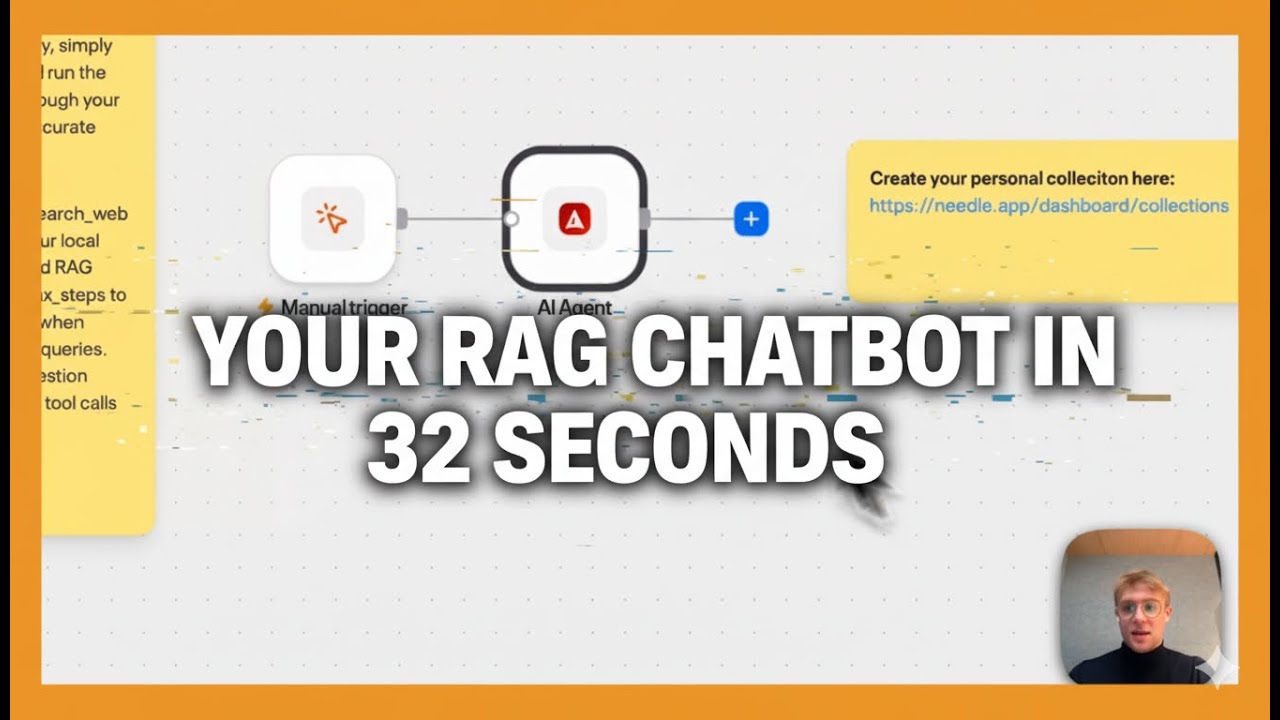
The New Way: 3 Steps to a RAG Chatbot
Here's how you build a RAG chatbot with Needle:
- Create a Collection - Set up a new collection in Needle (takes seconds)
- Upload your documents - PDFs, docs, websites, whatever your content is
- Start chatting - Your RAG chatbot is live and ready to answer questions
That's it. No vector database configuration. No embedding model selection. No chunking strategy debates.
The system handles all of that automatically. Your documents get indexed, optimized, and made searchable without you touching a single config file.
Traditional RAG Setup vs. Needle
| Step | Traditional RAG | Needle |
|---|---|---|
| Vector database | Choose, configure, and maintain (Pinecone, Weaviate, Qdrant, etc.) | Handled automatically |
| Embedding model | Research, select, and integrate | State-of-the-art, auto-selected |
| Chunking strategy | Define chunk size, overlap, and splitting logic | Optimized per content type |
| Retrieval tuning | Manual relevance testing and parameter adjustment | Automatically tuned |
| Setup time | Days to weeks | Minutes |
| Technical expertise required | Data engineering team | None |
What's Happening Under the Hood
We didn't remove the complexity - we abstracted it. Behind the scenes:
- Documents are automatically chunked using strategies optimized for your content type
- State-of-the-art embeddings are generated without you choosing models
- A production-ready vector store indexes everything
- Retrieval is automatically tuned for relevance
You get all the benefits of a properly configured RAG system without doing the configuration yourself.
Embed It Anywhere
Once your Collection is set up, you can embed the chatbot on your website with a single line of code. Customer support, internal knowledge bases, product documentation - whatever your use case.
The chatbot answers questions based on your documents and provides citations so users can verify the source.
Why We Built This
We kept seeing the same pattern: teams excited about RAG, teams starting RAG projects, teams abandoning RAG projects because the infrastructure overhead was too high.
The promise of "chat with your documents" shouldn't require a data engineering team to deliver. It should be as simple as uploading files and asking questions.
Now it is.
Summary
Building a RAG chatbot traditionally requires days of infrastructure work: choosing vector databases, selecting embedding models, configuring chunking strategies, and tuning retrieval. Needle eliminates all of this. In 3 steps - create a collection, upload documents, start chatting - you get a production-ready RAG chatbot with automatic chunking, state-of-the-art embeddings, and tuned retrieval. Embed it on any website with a single line of code, complete with source citations. The promise of "chat with your documents" is finally as simple as it should be.
Jan Heimes is Co-founder at Needle. He's never configured a chunk overlap parameter and never will.